
What Is the ROI of AI Patient Communication Software?
Discover the real ROI of AI patient communication software. Learn how clinics achieve a 300% to 600% immediate return by reducing no-shows, capturing missed calls, and saving staff hours.
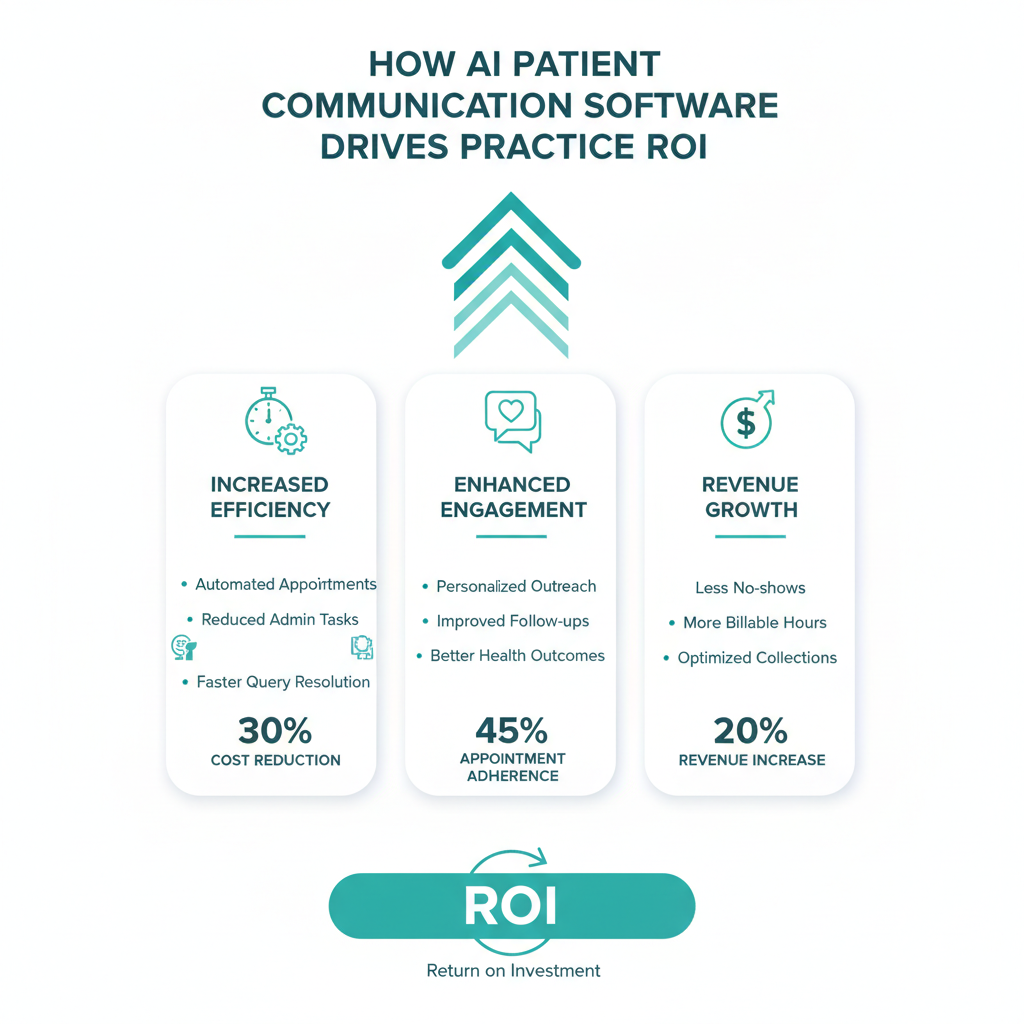
AI patient communication software delivers an average return on investment of $3.20 for every $1 spent, with typical returns realized within 14 months [1]. By automating scheduling, reminders, and missed-call responses, healthcare organizations recover 10 to 15 hours of administrative staff time per week and reduce no-show rates by 30% to 50% [2], [3]. For a mid-sized clinic with three practitioners, adopting AI communication software translates to an average financial return of $2,400 to $4,800 in monthly savings and recovered revenue, yielding an immediate ROI of 300% to 600% [11]. This financial impact is driven by a combination of front-desk labor savings, recovered revenue from missed appointments, and improved lead-to-client conversion rates [11]. To explore how your clinic can achieve these metrics, you can view our pricing plans or read through our related articles to see how automation transforms medical practice workflows.
How Does AI Patient Communication Software Generate ROI?
Investing in AI-driven patient communication tools is no longer just about keeping up with technology; it is a highly viable financial decision for modern healthcare practices. According to industry benchmarks, healthcare organizations implementing AI achieve an average return on investment of $3.20 for every $1 spent, with typical returns realized within 14 months [1]. This rapid financial viability helps practices easily justify upfront software costs. For most private practices, the financial return is driven by three main areas: * Administrative Labor Savings: By automating routine front-desk tasks, clinics can redirect staff energy toward high-value patient care and clinical coordination [2].
- Reduced Revenue Leakage: Automated workflows prevent missed appointments and fill empty slots without manual staff outreach [3], [7].
- Improved Patient Capture: Instantly responding to missed calls ensures patients book with your clinic instead of reaching out to competitors [8], [12].

Reducing No-Shows and Recovering Lost
Revenue Missed appointments are a major source of revenue leakage for healthcare providers. Implementing automated appointment reminders and multi-touch SMS sequences can reduce patient no-show rates by 30% to 50% [3]. These automated text reminders help maintain a predictable daily patient flow without requiring manual outreach from your staff [3]. Several real-world case studies demonstrate the massive financial impact of upgrading to automated communication platforms: * Saint Francis Health System: Upgraded from an outdated, phone-only system to a text-first patient engagement strategy using automated text reminders [9], [15]. This shift generated $3.1 million in additional revenue and reduced their patient no-show rate to 5.8%, while significantly reducing the volume of basic inquiry calls flooding their call center [9], [16].
- Maury Regional Health: Captured $500,000 in revenue from prevented no-shows and saved 155 call hours in one year by deploying text-first patient self-scheduling and waitlist tools [7], [10]. Integrating automated waitlist offers allowed the health system to fill empty appointment slots quickly, getting patients into care an average of 33 days sooner [7].
- Optometry Practice Case Study: An independent optometry practice using automated appointment reminders and recall tools reduced its no-show rate by 50% and saved staff 23 hours of manual phone work per month [5], [8].
Eliminating the Cost of Unanswered Calls
Many clinics do not realize how much revenue they lose from missed phone calls. Medical practices miss an average of 23% of incoming calls, and 62% of patients hang up without leaving a voicemail when they reach an unanswered line [4]. Because patients rarely leave messages and often call a competitor instead, missed calls represent a massive, silent source of revenue loss for busy clinics [4]. AI-powered virtual receptionists and automated text-back features solve this problem instantly. For example, automated missed-call text features can save offices up to two hours a day and help practices reduce missed opportunities by 70% [8], [12], [14]. Instantly texting back a patient when a call is missed keeps them engaged and prevents them from immediately reaching out to competing clinics [8].
Streamlining Workflows and Reducing
Call Volume By converting routine phone inquiries, such as prescription refills and scheduling questions, into structured, secure text threads, practices can dramatically lower their call volume. Practices using asynchronous messaging platforms report a 30% to 60% reduction in inbound phone call volume within 90 days [10]. This allows staff to answer inquiries in batches rather than constantly interrupting clinical workflows to answer the phone [10]. Centralizing communication tools also eliminates administrative friction. For example, Life Insight, a growing mental health practice with approximately 30 clinicians, achieved a 466% ROI and saved 30 hours per week for its care coordination team by centralizing communication [6], [9]. Consolidating phone, text, and fax into a single HIPAA-compliant inbox eliminated the need for staff to switch between multiple disconnected tools [6]. At About Conversify, we design AI-powered virtual receptionists and HIPAA-compliant client messaging tools specifically to help private dental, mental health, and medical practices replicate these exact efficiency gains.
How to Calculate Your Practice's AI
Communication ROI Calculating the potential ROI for your specific practice is straightforward. Follow these steps to estimate your savings and recovered revenue: * Estimate Lost Revenue from Missed Calls: Multiply your average monthly incoming calls by 23% (average missed rate), then by 62% (hang-up rate), and multiply by your average patient lifetime value to see what you are losing [4].
- Calculate No-Show Losses: Multiply your monthly appointments by your current no-show rate, then by the average appointment value. Estimate saving 30% to 50% of this loss by introducing automated multi-touch SMS reminders [3].
- Calculate Staff Labor Savings: Estimate recovering 10 to 15 hours per week per administrative staff member, multiplied by their hourly wage, by automating routine front-desk tasks [2].
- Compare Against Software Cost: Subtract your estimated software subscription cost from the sum of your recovered revenue and labor savings to find your net monthly return. By capturing missed calls, reducing no-shows, and freeing up staff time, the software pays for itself rapidly while elevating the patient experience. Practices ready to scale can explore these automated workflows to secure a predictable daily patient flow and substantial monthly savings.
Frequently Asked Questions
What is the average ROI of AI patient communication software?
Healthcare organizations implementing AI achieve an average return on investment of $3.20 for every $1 spent, with typical returns realized within 14 months [1]. For a mid-sized clinic with three practitioners, this translates to $2,400 to $4,800 in monthly savings and recovered revenue, representing an immediate ROI of 300% to 600% [11].
How does automated messaging reduce patient no-shows?
Implementing automated appointment reminders and multi-touch SMS sequences can reduce patient no-show rates by 30% to 50% [3]. By sending timely, interactive text reminders, practices maintain a predictable daily patient flow and prevent revenue leakage without requiring manual staff outreach [3].
What percentage of patient phone calls do medical practices miss?
On average, medical practices miss 23% of incoming calls, and 62% of patients hang up without leaving a voicemail when they reach an unanswered line [4]. This represents a significant, silent source of revenue loss as patients often call a competitor instead of waiting for a callback [4].
How much staff time can a clinic save by automating communication?
Private practices utilizing AI-powered client messaging, automated scheduling, and instant FAQ workflows typically recover 10 to 15 hours of administrative staff time per week [2]. This allows clinics to redirect front-desk staff energy away from repetitive tasks and toward high-value patient care [2].
Can centralizing communication tools improve a practice's financial return?
Yes, centralizing communication significantly boosts efficiency. For example, a growing mental health practice achieved a 466% ROI and saved 30 hours per week for its care coordination team by consolidating phone, text, and fax into a single HIPAA-compliant inbox [6].
How quickly can a clinic reduce its inbound phone call volume using asynchronous messaging?
Practices using asynchronous messaging platforms report a 30% to 60% reduction in inbound phone call volume within 90 days [10]. This reduction is achieved by converting routine phone inquiries, such as prescription refills and scheduling questions, into structured, secure text threads that staff can answer in batches [10].
Sources [1] Kissflow AI ROI Benchmarks
- Productive Edge Healthcare AI Solutions [3] Conversify App Patient Engagement [4] DoctorConnect Medical Practice Call Metrics [5] Proactive Chart Optometry Case Study [6] AgentZap Spruce Health Case Study [7] Medical Office Force Call Management [8] Solutionreach Optometry Recall Case Study [9] Spruce Health Communication Centralization [10] Luma Health Scheduling Integration [11] The Motley Fool Software ROI [12] Weave Automated Missed Call Text Feature [13] AVS Medical Software Integration [14] Weave Client Engagement Tools [15] Solutionreach Patient Texting Platform [16] Solutionreach Saint Francis Case Study
David Friedman - Founder, Conversify · LinkedIn
David Friedman is a B2B operations leader with over 10 years of experience managing large-scale teams and business processes. After years of working with service businesses and seeing how much time was lost to manual customer communication, he founded Conversify, an AI-powered platform that helps healthcare practices and service providers across Europe automate their patient and client interactions. David built the platform from the ground up, working directly with practicing healthcare professionals to ensure every feature solves a real operational pain point. He is based in Spain.