Virtual Receptionist Appointment Scheduling, Explained
A virtual receptionist can mean a human answering service, a booking page, or an AI front desk that books appointments itself. Here is how each handles scheduling.
Search for a virtual receptionist for appointment scheduling and you will meet three completely different products wearing the same name. There is the old-fashioned kind, a human agent at an answering service who picks up your line and takes a message. There is scheduling software, which hands customers a calendar and makes them do the work. And there is the new kind, an AI front desk like Conversify that reads each message, answers it, and books the appointment itself. Picking the right one starts with knowing they are not interchangeable.
The term has three meanings now
A human answering service. Remote agents answer your business line under your name, read from a script about your hours and services, take down the caller's details, and forward the message for you to call back. Billing is per call or per minute, commonly in the $1 to $3 a minute range once after-hours surcharges are included, with monthly plans that typically land somewhere between $135 and $500. We compare AI receptionists and answering services in depth here (/ai-receptionist-vs-answering-service) if you want the full cost breakdown.
Scheduling software. A booking page or widget. Calendly and its many cousins show your availability and let the customer pick a slot themselves. Cheap, reliable, and entirely self-serve. The catch is that it only serves the customer who already knows what they want. Someone asking what a service costs, whether Thursday or Friday works better, or whether they can bring a friend gets no answer at all, because there is no conversation, just a grid of times.
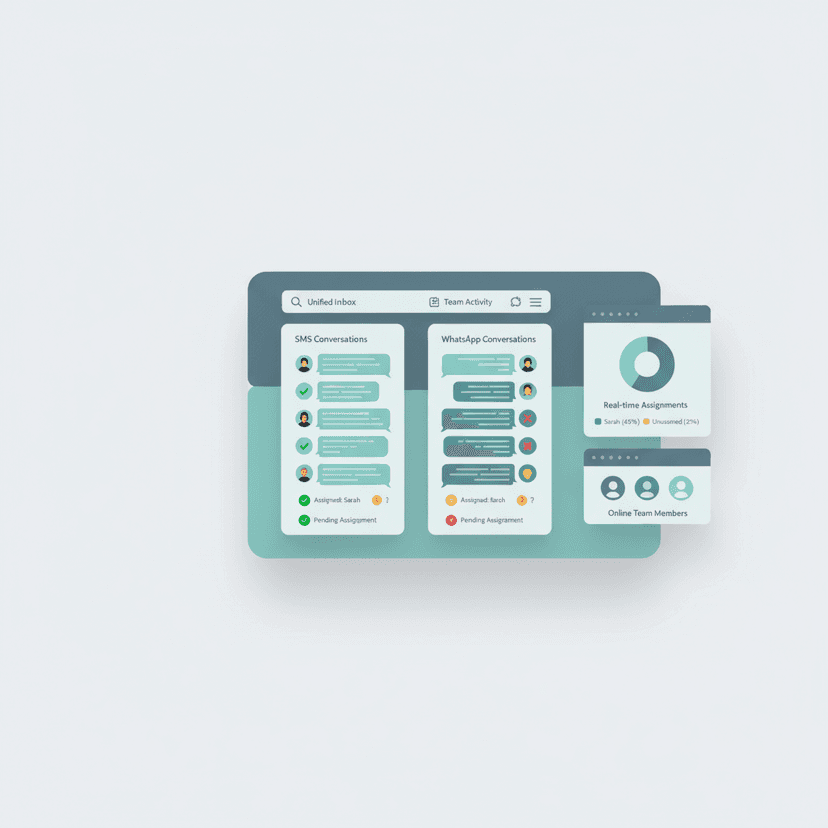
An AI front desk. Software that does what the first two cannot, together. It answers the customer's actual questions with your real prices and policies, checks your live calendar, offers slots, books, sends the confirmation, handles reschedules and cancellations, and remembers the customer for next time. Conversify runs this across WhatsApp, Instagram, Messenger, email, and web chat, around the clock, for a flat monthly fee.
How appointment scheduling works in each model
The differences show up fastest when you trace one customer through each system.
Intake. An answering service captures whatever the caller volunteers, usually a name and number, and maybe the service they wanted if the script asks. Scheduling software captures only what its form demands. An AI front desk converses, so it naturally collects the service, the preferred day, and any special request in the flow of the conversation, without making anyone fill out a form.
Calendar sync. This is the sharpest dividing line. Most answering services do not see your calendar at all. They relay a booking request and someone on your side still has to confirm it, which means the customer waits for a callback. Scheduling software has real calendar access, but only after the customer has decided on their own. An AI front desk has the calendar and the conversation in the same place: it quotes the price, offers the genuinely open slots, and books in one pass, with the slot gone from your calendar before the customer has finished reading the confirmation.
Confirmations and reminders. Answering services generally stop at the message. Scheduling software sends automated confirmations and reminders, and this is one thing they do well. An AI front desk does the same, and adds the recovery steps: a follow-up when a reply never comes, and a nudge when someone ghosts after asking about a slot.
Reschedules and cancellations. Here the answering service is weakest, because every change is another billable call and another relay. Scheduling software makes the customer rebook from scratch. An AI front desk treats "can we move it to Friday?" as a normal message, finds the new slot, updates the calendar, and confirms, in the same conversation.
Where the old model breaks
None of this is to say answering services are a scam. The model is just built for a business that no longer exists, in three specific ways.
It takes messages instead of finishing. A relayed booking request is work you still have to do. The customer asked to book and ended up in a queue. In the time the message takes to reach you and the callback to happen, some of those customers book somewhere else, silently.
It keeps business hours for a channel that never had them. Messaging volume skews heavily to evenings and weekends, exactly the hours a staffed service covers worst. The 9 pm message asking about tomorrow goes to a shared overnight center or voicemail, and by morning it is a day old.
The bill scales with your success. Per-minute pricing means your busiest month, the one where the front desk earned its keep, is also the most expensive one. Software pricing does the opposite: a flat monthly fee that stays put whether 20 customers write or 200.
What to check before choosing
Whatever you end up hiring or buying, run it through this list:
- Does it book appointments, or take messages about appointments? Ask directly, and do not accept "we can forward the request" as a yes.
- What are the real after-hours hours? Overnight, weekends, holidays, in writing.
- Does it sync with your actual calendar, so a slot it offers is a slot that exists?
- Are confirmations and reminders included, or a paid add-on?
- How are reschedules and cancellations handled, by whom, and how fast?
- Can it hold a deposit against no-shows, if your business needs that?
- When a conversation goes sideways, how does it reach a human, and how quickly?
- Is the pricing flat or usage-based, and what does your worst month look like on paper?
A surprising number of services and tools fail three or four of these questions at once. The ones that pass most of them tend to be either a serious answering contract with scheduling included, or an AI front desk.
Which one fits your business
A quick honest test: who are your customers, and how do they reach you?
If your phone genuinely rings all day with complex conversations, high-value leads, or matters where a calm human voice is the product, an answering service with scheduling included still earns its bill. Price the per-minute math against your call volume first, and read the after-hours clause before signing, not after.
If your customers are decisive, already know exactly what they want, and only need a grid of times, scheduling software does that job for almost nothing. Plenty of businesses keep a booking link in their Instagram bio and are perfectly happy.
If your customers ask questions before they commit, which is most of them, messaging is where those questions arrive, and nobody is answering them at 9 pm, the AI front desk is the one built for your situation. It is also the only option of the three that handles the whole arc: the question, the price, the booking, the reminder, the reschedule, and the review request, without you relaying anything.
Plenty of businesses mix and match. The AI covers messaging around the clock, a booking link serves the decisive minority, and a human line stays for the calls that genuinely need a voice. That combination costs a fraction of a full-time answering contract and nothing gets dropped.
What it costs
Answering services bill per call or per minute and typically land between $135 and $500 a month, rising with volume. Scheduling software runs from free to roughly $10 to $20 a month per seat. Conversify starts at $29 a month with unlimited staff seats, $89 for Growth, and $199 for Pro, flat regardless of how many customers write, with a 14-day free trial and no credit card. If what you actually want is the 9 pm message answered, priced, and booked before you wake up, the flat-fee option is the one built for it.
David Friedman - Founder, Conversify · LinkedIn
David Friedman is a B2B operations leader with over 10 years of experience managing large-scale teams and business processes. After years of working with service businesses and seeing how much time was lost to manual customer communication, he founded Conversify, an AI-powered platform that helps healthcare practices and service providers across Europe automate their patient and client interactions. David built the platform from the ground up, working directly with practicing healthcare professionals to ensure every feature solves a real operational pain point. He is based in Spain.