

How to Set Up an AI Auto-Responder Without Changing Your Number
Discover how to implement an AI-powered missed call text-back system using your existing business number. Keep your voice carrier intact while capturing lost leads instantly.
Setting up an AI auto-responder without changing your business phone number is achieved through hosted SMS and conditional call forwarding. By integrating Conversify, businesses can add automated text messaging capabilities to their existing landline or VoIP number while leaving their current voice service completely untouched, ensuring they never miss another high-intent lead. This modern setup separates voice and text routing. Your voice calls continue to ring through your current carrier normally, while text traffic is routed to an intelligent messaging platform. Because small businesses miss approximately 62% of incoming calls [1] [2], this system captures lost revenue immediately. Implementing this solution requires no porting or downtime, allowing service businesses to maintain their established local numbers on marketing materials while upgrading to an AI-powered front desk that instantly engages missed callers via SMS. With about 85% of callers who reach voicemail refusing to call back [1], an instant auto-response is critical for survival.
Why Missed Calls Are Quietly Draining
Your Revenue Every missed call represents a lost opportunity, a reality that heavily impacts small business bottom lines. Research indicates that small businesses miss approximately 62% of incoming calls [1] [2]. This high rate of unanswered calls often leads to significant revenue loss, as many callers are high-intent leads looking for immediate assistance. When a prospect calls a service provider, they are typically ready to book. If no one answers, they rarely wait. In fact, approximately 85% of callers who reach a business's voicemail never call back [1]. Instead of leaving a message or waiting for a return call, the majority of these prospects will immediately contact a competitor. This constant leakage of potential clients adds up quickly. On average, missed calls cost small businesses approximately $126,000 per year in lost revenue [3]. This estimate accounts for the lifetime value of lost customers, particularly in high-value industries like professional services, legal assistance, and home services. Consider the impact on service practices. These providers miss 34% of calls during business hours, and each missed visit costs providers approximately $200 [1]. For these professional offices, even a single missed client visit per day can compound into a $15,000 annual loss [1]. The solution lies in speed. Responding to a lead within 5 minutes increases contact rates by up to 100x compared to slower response times [11]. Sending an automated text-back within seconds of a missed call captures the prospect's attention while they still have their phone in hand, preventing them from calling a competitor. 
The Technology Behind Keeping Your Existing
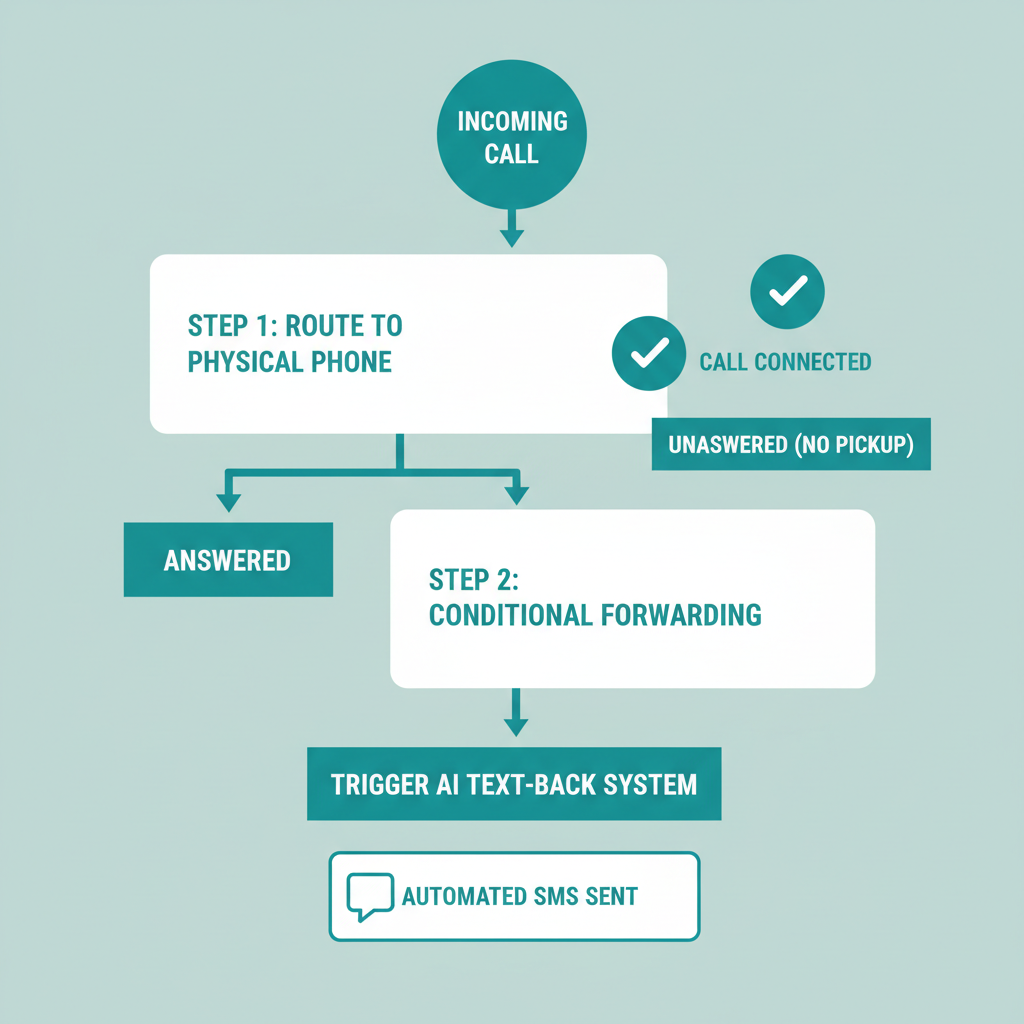
Number Many business owners hesitate to implement automated texting because they fear losing their established local numbers or undergoing a complex porting process. Fortunately, modern telecommunications technology eliminates this obstacle entirely through two key mechanisms: Hosted SMS and Conditional Call Forwarding. Hosted SMS technology adds text messaging capabilities to an existing landline or VoIP number while leaving the voice service untouched with the current carrier [6] [7]. This setup separates voice and text routing, ensuring that voice calls continue to ring through normally to your desk phones or existing systems, while text traffic is handled by a separate messaging carrier [6]. There is no downtime, no carrier migration, and no risk of losing your voice service. The second piece of the puzzle is Conditional Call Forwarding (CCF). Unlike standard call forwarding, which redirects all incoming calls immediately, Conditional Call Forwarding redirects incoming calls to an automation system only when the line is busy, unanswered, or declined [7]. This allows your primary phone to ring first, giving your staff the opportunity to answer. If a live person does not answer within a set number of rings, the call is seamlessly routed to the automation system to trigger the text-back workflow [7] [8]. This system is entirely risk-free. Conditional Call Forwarding can be easily deactivated at any time using carrier-specific codes, such as *73 for Verizon or ##004
for AT&T and T-Mobile [8]. This provides business owners with a flexible setup, as they can revert back to standard carrier voicemail without disrupting their primary line.
Step-by-Step Guide: How to Set Up an
AI Auto-Responder Setting up an AI auto-responder with your existing number is a straightforward process when using a dedicated platform. Here is how you can implement this system for your business: - Choose Your AI Platform: Select a comprehensive platform like Conversify that offers AI-powered responses, appointment booking, and a unified inbox. Review their pricing plans to find the right fit for your call volume.
- Enable Hosted SMS: Provide your existing business phone number to the platform. The provider will configure Hosted SMS behind the scenes, allowing your number to send and receive text messages without changing your voice carrier [6] [7].
- Complete 10DLC Registration: Since 2023, business SMS in the US and Canada requires 10DLC (10-Digit Long Code) registration to ensure message deliverability and carrier compliance [9]. Reputable business texting platforms handle this registration process to prevent automated text-back messages from being blocked by mobile carriers [9].
- Configure Conditional Call Forwarding: Use your carrier's specific activation codes to forward missed, busy, or unanswered calls to the routing number provided by your AI platform [7] [8].
Standard Auto-Responders vs.
AI-Powered Assistants When exploring text-back solutions, it is important to distinguish between standard auto-responders and AI-powered systems. While both prevent immediate lead loss, their long-term conversion rates differ significantly. Standard missed call text-back systems simply send a single, static "sorry we missed you" message [10]. While this acknowledges the caller, it requires a human team member to manually take over the conversation to answer questions or book an appointment. If your team is busy, the lead may still go cold. In contrast, AI-powered missed call text-back systems can read voicemail transcripts, ask qualifying questions, and offer open calendar slots to book appointments [10]. While standard auto-responders only send a single message, AI systems maintain a multi-turn conversation to actively convert the lead [10]. This ensures that even if a call comes in after hours, the customer can complete their booking without human intervention.
| Feature | Standard Auto-Responder | AI-Powered Assistant (Conversify) |
|---|---|---|
| Initial Response | Sends a single static SMS | Sends a personalized, context-aware SMS |
| Conversation Flow | One-way notification | Multi-turn, natural conversation |
| Lead Qualification | None | Asks custom qualifying questions |
| Appointment Booking | Sends a static link | Reads calendar and books slots directly |
| Voicemail Integration | None | Reads and responds to voicemail transcripts |
Maximizing Lead Conversion with Conversify
Integrating an AI auto-responder is not just about sending a quick text; it is about creating a seamless, multi-channel communication experience. Conversify provides a unified inbox that consolidates messages from SMS, WhatsApp, and social media into a single dashboard. This allows your team to monitor AI conversations and step in whenever a personal touch is needed. By automating the initial contact, you ensure that 100% of your incoming leads receive an immediate response. The AI assistant can handle routine inquiries, qualify prospects based on your specific criteria, and guide them directly to your booking page. This drastically reduces administrative overhead while keeping your calendar filled. For more strategies on optimizing your customer communication, explore our related articles. 
Frequently Asked Questions
Will setting up a text-back system affect my current voice service?
No, setting up a missed call text-back system will not affect your current voice service. Hosted SMS technology adds text messaging capabilities to your existing landline or VoIP number while leaving the voice routing untouched with your current carrier [6]. Your phone will continue to ring normally, and customers can place calls exactly as they did before.
What is Conditional Call Forwarding and how does it work?
Conditional Call Forwarding is a carrier feature that redirects incoming calls to an automation system only when your primary line is busy, unanswered, or declined [7]. Unlike standard call forwarding, which redirects all calls immediately, this setup allows your primary phone to ring first [7]. If no one answers, the call is sent to your AI platform to trigger an automated text response [8].
Can I turn off the text-back system if I change my mind?
Yes, you can deactivate the text-back system at any time using simple carrier-specific codes [8]. This makes the setup completely risk-free, allowing you to return to your standard carrier voicemail instantly.
What is 10DLC registration and why is it required?
Since 2023, business SMS in the US and Canada requires 10DLC (10-Digit Long Code) registration to ensure message deliverability and carrier compliance [9]. This process registers your business identity with mobile carriers to prevent your automated text-back messages from being filtered or blocked as spam [9]. Reputable platforms like Conversify handle this registration process for you.
How does an AI auto-responder differ from a standard text-back?
A standard text-back system only sends a single, static "sorry we missed you" message to the caller [10]. An AI-powered system can read voicemail transcripts, ask custom qualifying questions, and offer open calendar slots to book appointments [10]. This enables the AI to maintain a multi-turn conversation and actively convert the lead without human intervention [10].
How much revenue do small businesses lose from missed calls?
On average, missed calls cost small businesses approximately $126,000 per year in lost revenue when accounting for the lifetime value of lost customers [3]. This is largely because about 85% of callers who reach a voicemail never call back, choosing instead to contact a competitor immediately [1]. Implementing an AI auto-responder setup is one of the fastest ways to recover lost revenue and improve customer satisfaction. By leveraging hosted SMS and conditional call forwarding, you can protect your established business number while upgrading your customer experience. Platforms like Conversify make this transition seamless, ensuring that every missed call is transformed into an active, booked conversation.
Sources [1] Missed Business Calls Statistics
- How Many Calls Do Small Businesses Miss? Key Stats
- The True Cost of Missed Calls
- Missed Call SMS Glossary
- Missed Call Text Back Setup Guide
- Hosted SMS Messaging Services
- Landline Text Messaging Platform Solutions
- What is a Missed Call Text Back?
- Missed Call Auto-Respond Systems
- Using AI to Respond to Missed Calls
- AI Receptionist and Missed Call Text Back
David Friedman - Founder, Conversify · LinkedIn
David Friedman is a B2B operations leader with over 10 years of experience managing large-scale teams and business processes. After years of working with service businesses and seeing how much time was lost to manual customer communication, he founded Conversify, an AI-powered platform that helps healthcare practices and service providers across Europe automate their patient and client interactions. David built the platform from the ground up, working directly with practicing healthcare professionals to ensure every feature solves a real operational pain point. He is based in Spain.