

Is an AI Receptionist Worth It for Service Businesses?
Is an AI receptionist worth the setup, or is it just another tool to maintain? Discover how service businesses recover lost revenue and save thousands annually with automated call handling.
An AI receptionist refers to an automated software solution that handles customer calls, schedules appointments, and answers inquiries without human intervention.2x in the first year alone [4]. Rather than being just another tool to maintain, this technology addresses critical operational leaks. Statistics show that only 37.8% of calls to small businesses are answered by a live person, costing the average business roughly $126,000 annually in lost revenue [3]. This self-contained setup ensures after hours and overflow calls are answered immediately, transforming a potential administrative headache into a seamless, high-yield revenue generator. For many business owners, the hesitation to adopt new technology comes from a fear of complicated setups and endless maintenance. It is easy to look at AI as just another subscription invoice that requires constant troubleshooting. However, when you look at the actual data from service businesses that have made the switch, a very different picture emerges. To learn more about our mission to support local businesses, you can read About Conversify.
Why Are Service Businesses Missing So Many Calls?
Many business owners underestimate how many potential clients they lose simply because the phone goes unanswered. According to data from NextPhone, 28.5% of business calls arrive outside of standard business hours, and 34.8% of those after-hours callers express clear buying intent [5]. When these calls go unanswered, they do not just wait for the next business day. In fact, research from Magicline.ai reveals that approximately 85% of callers who reach a small business's voicemail hang up without leaving any message at all, and 62% will immediately call a competitor instead [9]. Local service leads convert at much higher rates when they receive a response within five minutes. If your front desk is busy assisting an in-person client, or if the call comes in at late hours or during a weekend, that lead is almost certainly lost. By utilizing an AI receptionist, you establish an instant response system. Whether a call arrives at midnight or during a peak afternoon rush, the AI answers immediately, captures the lead's details, and books the appointment directly into your calendar.
The True Cost of Front Desk Turnover
and Staffing Gaps Running a service business requires a reliable team, but keeping a front desk fully staffed has become an uphill battle. According to workforce surveys and industry data compiled by Claire Research, front desk turnover hit a multi-year peak of approximately 47% in 2025 [7]. Even worse, the average time to fill an open receptionist role stretched to 62 days [7]. When a front desk position remains open for over two months, the operational disruption is massive. Existing staff members experience severe burnout as they attempt to juggle their core responsibilities alongside answering phones and scheduling appointments. This environment leads to mistakes, dropped balls, and further turnover.  Implementing an AI receptionist helps service businesses mitigate these severe operational disruptions. The AI acts as a permanent, unbreakable safety net. It does not take sick days, it does not resign with two weeks' notice, and it ensures that your business operations remain smooth and consistent even during prolonged staffing gaps.
How Much Money Can an AI Receptionist Actually Save Your Business?
The financial comparison between a traditional receptionist and an AI alternative is stark. Research from Smith.ai indicates that switching to an AI receptionist saves businesses an average of $36,000 annually [3]. How is this dramatic cost reduction achieved? Consider the traditional model: - Hiring a full-time human receptionist typically costs between $30,000 and $60,000 per year, excluding benefits, taxes, and onboarding expenses.
- In contrast, an AI receptionist subscription ranges from just $600 to $4,800 annually. By reviewing pricing plans, business owners can easily see how replacing or supplementing traditional front-desk coverage with AI dramatically lowers overhead. This is why a Forrester TEI Analysis reports that businesses achieve an average return on investment of 4.2x in the first year of deploying AI receptionist solutions [4]. The upfront configuration costs are quickly offset by recovered revenue from captured leads and significantly reduced labor expenses.
Is the Setup and Maintenance Overhead Worth It?
The biggest concern for small business owners is whether an AI tool will become a "second job" to maintain. If you have to spend hours every week fixing broken integrations or correcting AI mistakes, the tool is not saving you time. However, the long-term data shows that setup overhead is a minor hurdle compared to the ongoing value. Analysis from Globe Market Research reveals that 81% of businesses that adopt AI receptionists keep them after 12 months [6]. This exceptionally high retention rate suggests that small businesses find the setup and maintenance overhead of AI voice agents well worth the long-term operational value. 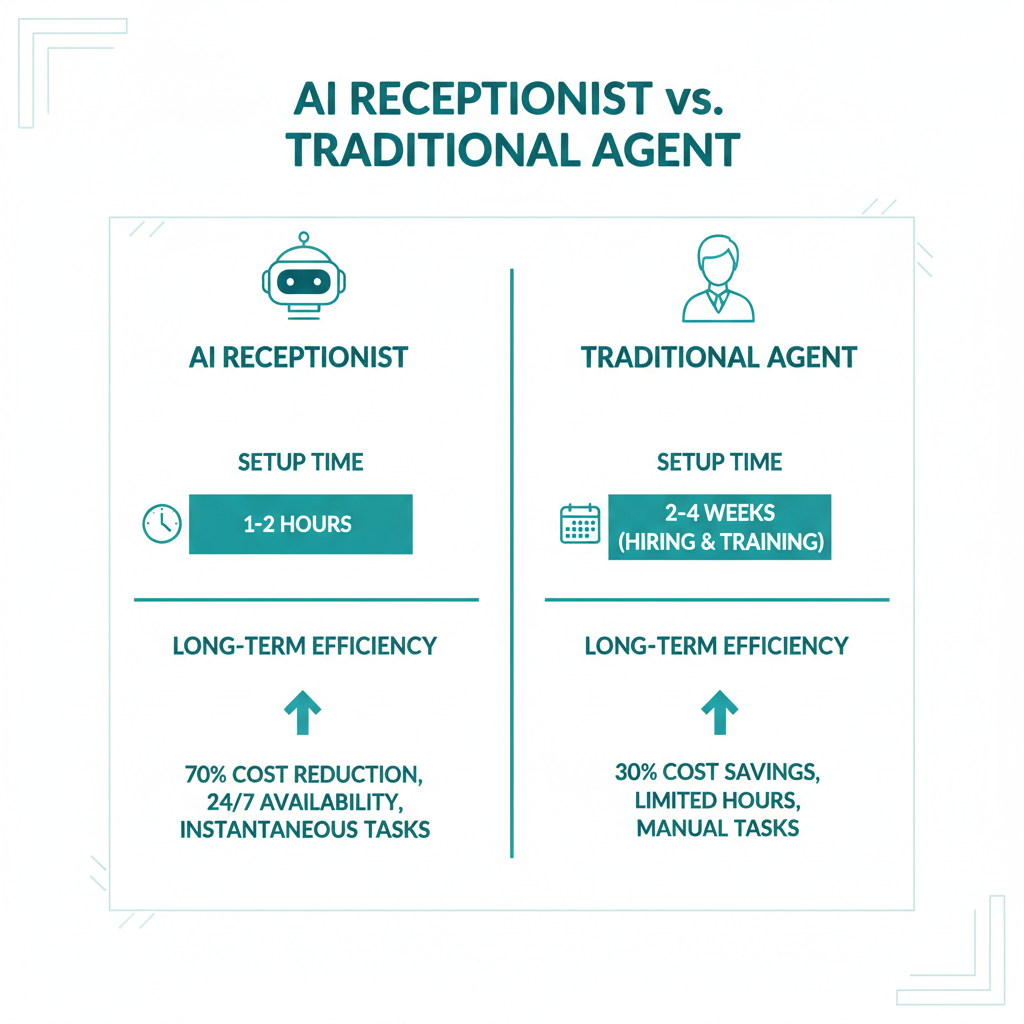 Furthermore, according to a 2026 statistical roundup by Resonate, service providers achieve a 30% improvement in administrative efficiency after implementing AI receptionists [1]. This efficiency boost helps businesses manage high client volumes without needing to hire additional staff. Once configured, the AI runs quietly in the background, handling the vast majority of inbound traffic with minimal human oversight.
How to Set Up an AI Receptionist for
Your Business Setting up an AI receptionist does not require a degree in computer science. By following a structured approach, you can have a fully automated front desk running in just a few days. Here is how to get started: - Define your routine call flows: Identify the most common questions your business receives. According to a Deloitte industry study, 70% of routine calls require no human intervention when AI receptionists are properly configured [8]. List these repetitive tasks, such as booking appointments, verifying details, or checking order statuses.
- Map out your integration points: Connect your AI receptionist to your existing calendar, customer relationship management software, and communication channels like WhatsApp or SMS.
- Write clear response guidelines: Feed the AI your business hours, pricing, services, and policies so it can answer questions accurately.
- Set up human handoff rules: Determine which complex or sensitive inquiries should be routed directly to a live staff member.
- Test and launch: Run test calls with your team to ensure the AI speaks in your brand's voice and handles bookings correctly before pushing it live.
Will AI Completely Replace Your Front Desk Staff?
A common misconception is that implementing AI means firing your entire reception team. In reality, the most successful businesses use a hybrid model. A 2023 Accenture report highlights that 73% of service executives expect AI to automate at least half of administrative tasks within five years, but only 14% anticipate full replacement of human roles [8]. This indicates that AI receptionists are best utilized as hybrid tools that handle routine inquiries and scheduling, leaving complex, high-value, or sensitive client interactions to human staff.  Furthermore, Gartner predicts that 80% of customer service organizations will use generative AI by 2025, improving agent productivity by 30% to 50% [4]. For small service businesses, this shift indicates that AI receptionists are rapidly transitioning from an experimental novelty to standard operational infrastructure. By automating the repetitive 70% of calls [8], your human staff can focus on delivering exceptional in-person experiences and building long-term client relationships.
Frequently Asked Questions
Is an AI receptionist difficult to maintain after the initial setup?
No, once the initial configuration is complete, maintenance is minimal. Most service businesses only need to update their AI guidelines when pricing, services, or business hours change, which takes just a few minutes.
Can an AI receptionist handle complex customer inquiries?
AI receptionists are designed to handle routine tasks like scheduling, basic FAQs, and lead capture. For complex or highly sensitive inquiries, the system is configured to seamlessly hand off the conversation to a human staff member.
What happens to callers who refuse to speak with an AI?
If a caller prefers human interaction, the AI receptionist can instantly route the call to a live staff member or offer to have a representative call them back. This ensures no customer is left frustrated or ignored.
How does an AI receptionist improve lead conversion rates?
Since 85% of callers hang up when sent to voicemail [9], the AI's ability to answer instantly prevents lead abandonment. By responding within seconds and booking appointments on the spot, you secure clients before they call a competitor.
Is an AI receptionist secure and compliant with privacy standards?
Yes, reputable AI receptionist platforms use secure, encrypted data transfers to protect customer information. They integrate safely with your existing software platforms to ensure all data remains private and secure.
How much does an AI receptionist cost compared to a human employee?
An AI receptionist subscription typically costs between $600 and $4,800 annually, whereas a full-time human receptionist costs $30,000 to $60,000 per year. This represents an average annual savings of $36,000 for small businesses [3].
Sources
- [Resonate AI Receptionist
- PatientDesk Industry Analysis
- SchedulingKit AI Receptionist Statistics
- Growth100x Small Business AI Insights
- NextPhone AI Receptionist Statistics
- Globe Market Research AI Receptionist Market Statistics
- Claire Research State of AI Receptionists
- DoctorConnect AI Receptionist Capabilities and Costs
- Magicline AI Receptionist Statistics
Conclusion Ultimately, implementing
an AI receptionist is not about adding another tedious tool to your tech stack; it is about plugging the leaks in your business's revenue and operations. For more guides on how to optimize your operations, check out our related articles.
David Friedman - Founder, Conversify · LinkedIn
David Friedman is a B2B operations leader with over 10 years of experience managing large-scale teams and business processes. After years of working with service businesses and seeing how much time was lost to manual customer communication, he founded Conversify, an AI-powered platform that helps healthcare practices and service providers across Europe automate their patient and client interactions. David built the platform from the ground up, working directly with practicing healthcare professionals to ensure every feature solves a real operational pain point. He is based in Spain.