How to Automate Customer Satisfaction Surveys for High Response Rates
Discover how automating your customer satisfaction surveys can drive higher response rates. Learn why WhatsApp and conversational messaging outperform traditional email surveys.
To automate customer satisfaction surveys, businesses integrate communication tools like Conversify to trigger conversational feedback requests immediately after service delivery. By sending automated, mobile native surveys via WhatsApp, businesses can capture customer feedback automatically and increase response rates up to 65 percent compared to traditional methods [1].
Traditional feedback collection is broken. According to Dialpad, the response rate of traditional customer satisfaction (CSAT) surveys is only 3 percent [3]. This low participation rate often leads to biased data because only extremely happy or extremely unhappy customers respond, leaving out the massive middle ground of customers [3].
Modern automation solves this by replacing friction filled email forms with real time, conversational messaging. Moving to digital satisfaction surveys in service environments achieves a 36 percent response rate, compared to just 22 percent for paper based options [1]. By utilizing automated messaging platforms, service businesses can establish consistent feedback loops without manual administrative overhead.
To see how your business can leverage these automated conversational workflows, check out the About Conversify page to learn more about our mission. You can also explore our pricing plans to find a solution that fits your business scale, or read our related articles for more insights on customer communication.
Why Traditional Customer Satisfaction Surveys Fail
Traditional customer satisfaction surveys have long been a staple of operational feedback strategies, yet they are increasingly ineffective. The primary issue lies in the channel and the format. Most organizations rely on email-based feedback forms or physical comment cards, both of which require significant effort from the consumer.
According to research by Dialpad, the response rate of traditional customer satisfaction (CSAT) surveys is a mere 3 percent [3]. This extremely low response rate creates a major statistical problem known as response bias. When only 3 percent of your customer base responds, the data you collect is highly skewed. Typically, the only individuals motivated enough to click a link, open a browser, and fill out a multi-page form are those who had an exceptionally positive experience or an exceptionally negative one [3].
This dynamic completely leaves out the massive middle ground of customers who had a standard, satisfactory, or slightly mediocre experience [3]. Without feedback from this silent majority, service businesses remain blind to minor operational issues that could eventually lead to customer churn. To make matters worse, traditional surveys are often sent days or weeks after the transaction, making it difficult for customers to recall specific details of their experience.
The Benefits of Transitioning to Automated Digital Surveys
Transitioning from manual, paper-based surveys or delayed emails to automated digital workflows completely transforms the feedback loop. In service-based environments, digital satisfaction surveys achieve a 36 percent response rate, compared to just 22 percent for paper-based options [1].
Eliminating manual data entry is only the beginning. Automated digital surveys allow businesses to address complaints and resolve customer issues in real time [1]. When a customer submits a low rating, the automated system can immediately alert a manager or route the conversation to a customer support specialist. This rapid intervention can turn a negative experience into a positive one before the customer has a chance to post a public review.
This level of automation is highly effective across various service sectors. In specialized service environments, automated text messaging achieves 96 percent reach rates and 83 percent survey response rates [4]. This high engagement allows organizations to gather reliable feedback without requiring manual distribution or administrative follow-up [4].
Furthermore, one service facility increased its satisfaction scores from 83 percent to 100 percent through automated communication and feedback systems [5]. Automating touchpoints and post-appointment surveys helps organizations quickly identify service bottlenecks and improve the overall customer experience [5]. By removing human error and administrative delays, businesses can ensure that every single customer is asked for feedback at the perfect moment.
Why WhatsApp is the Ultimate Channel for Survey Automation
If you want to maximize your survey response rates, you must meet your customers where they already spend their time. Traditional email is cluttered with promotions, spam, and work-related messages, causing survey requests to be easily ignored or lost.
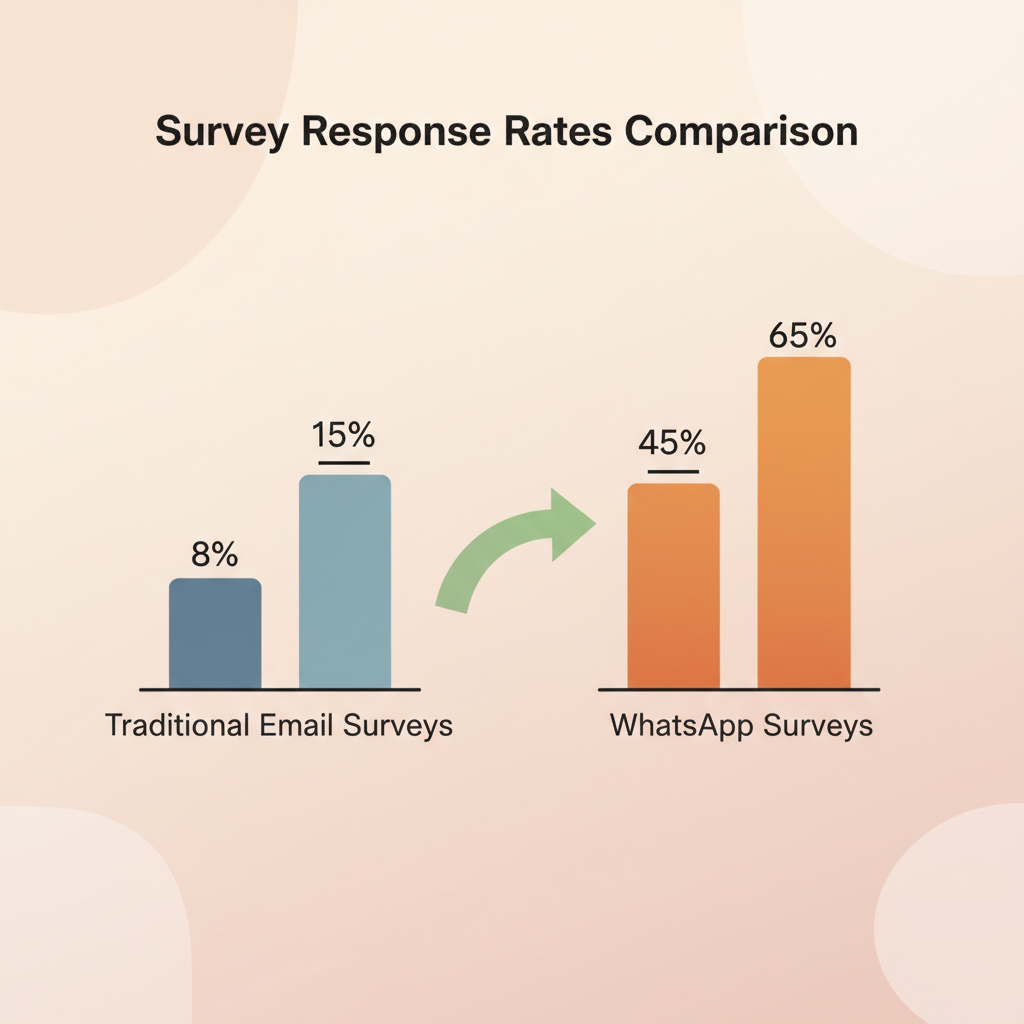
WhatsApp Net Promoter Score (NPS) surveys achieve response rates of 45 percent to 65 percent, compared to just 8 percent to 15 percent for traditional email surveys [1]. This dramatic difference highlights how switching to mobile-native messaging channels can help service businesses capture significantly more feedback [1].
Implementing WhatsApp review requests has been shown to drive an 84 percent increase in response rates compared to email [2]. The secret to this success lies in the nature of conversational feedback flows. Unlike traditional surveys that redirect users to an external website or a complex web form, conversational surveys deliver each question as a direct message within the chat [2]. The customer can reply with a simple tap or a quick text, making the process feel like a natural conversation rather than a chore.
This conversational approach is highly effective even in formal, highly regulated sectors where customer communication is traditionally rigid. For instance, in financial services, Optimyze Finance achieved a 33 percent response rate using conversational feedback collection on WhatsApp [1]. This proves that customers prefer the convenience of chat-based communication over formal emails, regardless of the industry.
How to Automate Customer Satisfaction Surveys
Setting up an automated survey system does not have to be complicated. By using an AI-powered customer communication platform like Conversify, you can easily build and deploy conversational feedback flows. Here is a step-by-step guide to automating your customer satisfaction surveys:
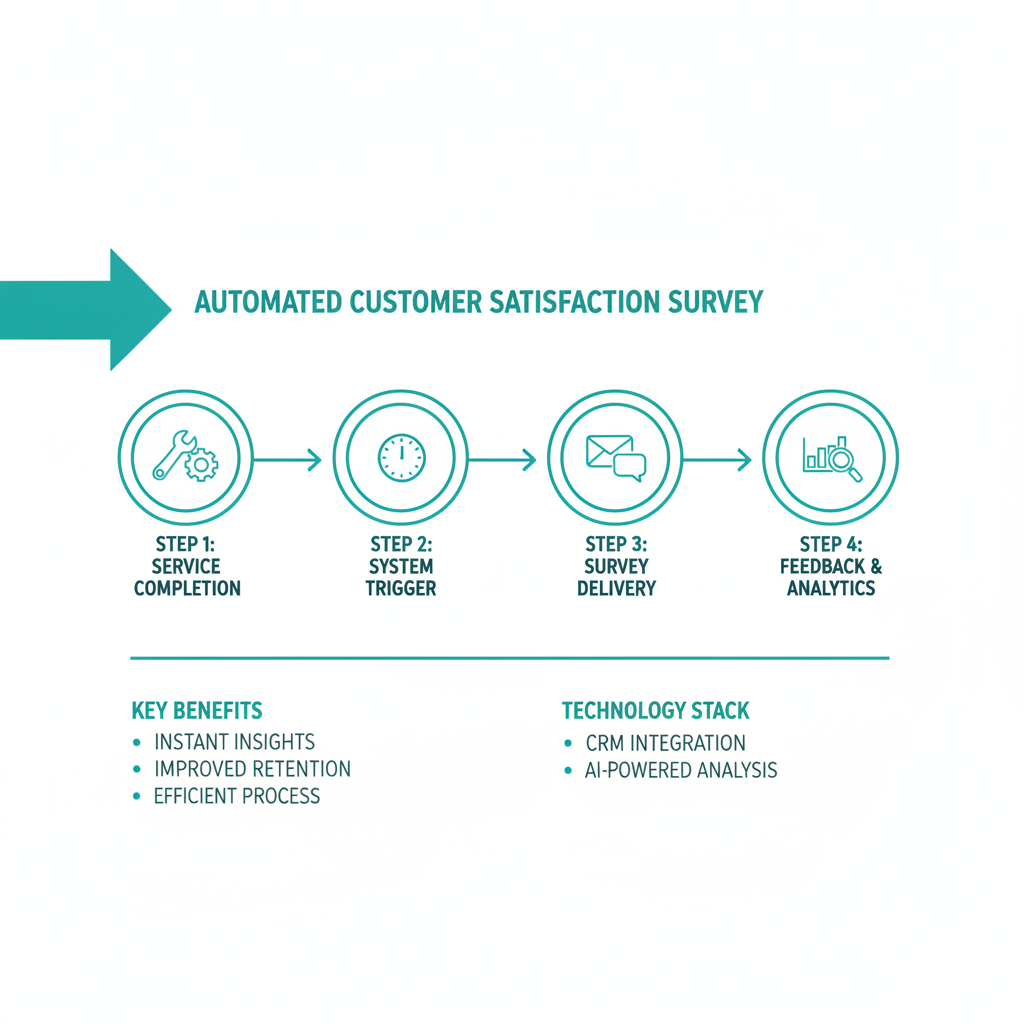
- Select a Mobile-First Communication Platform: Choose a tool that supports conversational messaging channels like WhatsApp and SMS. Look for features like a unified inbox and automated workflows.
- Integrate Your Customer Database: Connect your booking system, CRM, or POS to your communication platform. This ensures customer data flows seamlessly between systems.
- Design a Conversational Feedback Flow: Instead of sending a link to a long form, break your survey down into individual, interactive questions. Ask one question at a time directly in the chat.
- Set Up Automated Triggers Based on Activity: Program your system to send the survey automatically after a specific event, such as a completed service or a resolved support ticket.
- Establish a Real-Time Alert System: Configure notifications so that your team is alerted immediately if a customer submits a low score, allowing for instant service recovery.
The Power of Timing: Why the 24-Hour Rule Matters
In the service industry, timing is everything. The closer the survey is to the actual service delivery, the more accurate and abundant your feedback will be.
Automating surveys within 24 hours of job completion increases CSAT response rates by three to five times [1]. Capturing feedback immediately after a service is finished ensures the experience is fresh in the customer's mind [1].
When you wait too long to ask for feedback, the customer's memory fades, and their emotional connection to the service decreases. This delay results in lower response rates and vague, unhelpful feedback. By automating the process to trigger a survey immediately after a service is marked as complete, you capitalize on the customer's peak engagement.
Balancing Automation with the Human Touch
While automating surveys and scheduling is highly efficient, businesses must balance automation with human touchpoints to avoid making customers feel like they are being routed solely to save money [7].
According to a SurveyMonkey report on customer experience, 79 percent of US consumers strongly prefer interacting with a human compared to an AI agent [7]. Furthermore, Gladly's 2026 research reveals that 88 percent of customers had issues resolved through AI or hybrid interactions, but only 22 percent said it made them prefer the company [7]. This highlights that while AI-driven automation can successfully resolve customer queries, it does not automatically build brand loyalty unless integrated thoughtfully into the customer journey [7].

To solve this challenge, businesses should adopt a hybrid customer service model. Platforms like Conversify allow you to use AI receptionists to handle routine tasks, scheduling, and survey distribution, while ensuring that human staff can step in whenever a customer needs personal attention. This ensures your operations remain incredibly efficient without sacrificing the personal touch that builds long-term brand loyalty.
Automating your customer satisfaction surveys is a powerful way to transform sparse, biased feedback into actionable operational insights. By transitioning from low-yield email forms to high-engagement conversational channels like WhatsApp, service businesses can significantly increase response rates and intercept negative reviews before they go public. Platforms like Conversify make this transition effortless by blending AI-powered messaging with a unified human inbox, ensuring your customers always experience the perfect balance of efficiency and personal care.
Frequently Asked Questions
What is the average response rate for traditional CSAT surveys?
According to Dialpad, the response rate for traditional customer satisfaction (CSAT) surveys is only 3 percent [3]. This incredibly low rate often results in biased data because only highly polarized customers participate, leaving out the average customer experience [3].
Why does WhatsApp achieve higher survey response rates than email?
WhatsApp surveys achieve response rates of 45 percent to 65 percent, compared to just 8 percent to 15 percent for email [1]. This is because conversational messaging flows deliver questions directly to a user's mobile device as interactive messages, reducing the friction of clicking external links [2].
When is the best time to send an automated satisfaction survey?
Research shows that automating surveys within 24 hours of job completion increases CSAT response rates by three to five times [1]. Sending the survey immediately ensures the service experience is fresh in the customer's mind, resulting in more accurate and timely feedback [1].
Can automated surveys be used in highly regulated industries?
Yes, conversational survey automation is highly effective even in formal and regulated sectors. For example, the financial services firm Optimyze Finance achieved a 33 percent response rate using conversational survey collection on WhatsApp [1].
How do digital satisfaction surveys compare to paper-based surveys?
Digital satisfaction surveys in service-based environments achieve a 36 percent response rate, whereas paper-based options only reach 22 percent [1]. Transitioning to digital workflows eliminates manual data entry and enables businesses to address customer issues in real time [1].
How can businesses prevent customers from feeling alienated by automated surveys?
Businesses must balance automated survey flows with human touchpoints to maintain customer loyalty. While automation is highly efficient, 79 percent of consumers still prefer interacting with humans, and automated resolutions alone do not automatically build brand affinity [7].
Sources
David Friedman - Founder, Conversify · LinkedIn
David Friedman is a B2B operations leader with over 10 years of experience managing large-scale teams and business processes. After years of working with service businesses and seeing how much time was lost to manual customer communication, he founded Conversify, an AI-powered platform that helps healthcare practices and service providers across Europe automate their patient and client interactions. David built the platform from the ground up, working directly with practicing healthcare professionals to ensure every feature solves a real operational pain point. He is based in Spain.