Is an AI Receptionist Worth It? Costs, ROI, and Savings
Is an AI receptionist worth the investment for your small business? Explore the real costs, ROI, and administrative savings of front desk automation.
Yes, an AI receptionist is worth it because it delivers an average net ROI of 300% to 500% [1] by capturing missed calls and automating bookings. For small service businesses, platforms like Conversify resolve up to 70% of routine calls without human intervention [3], making the technology highly cost-effective.
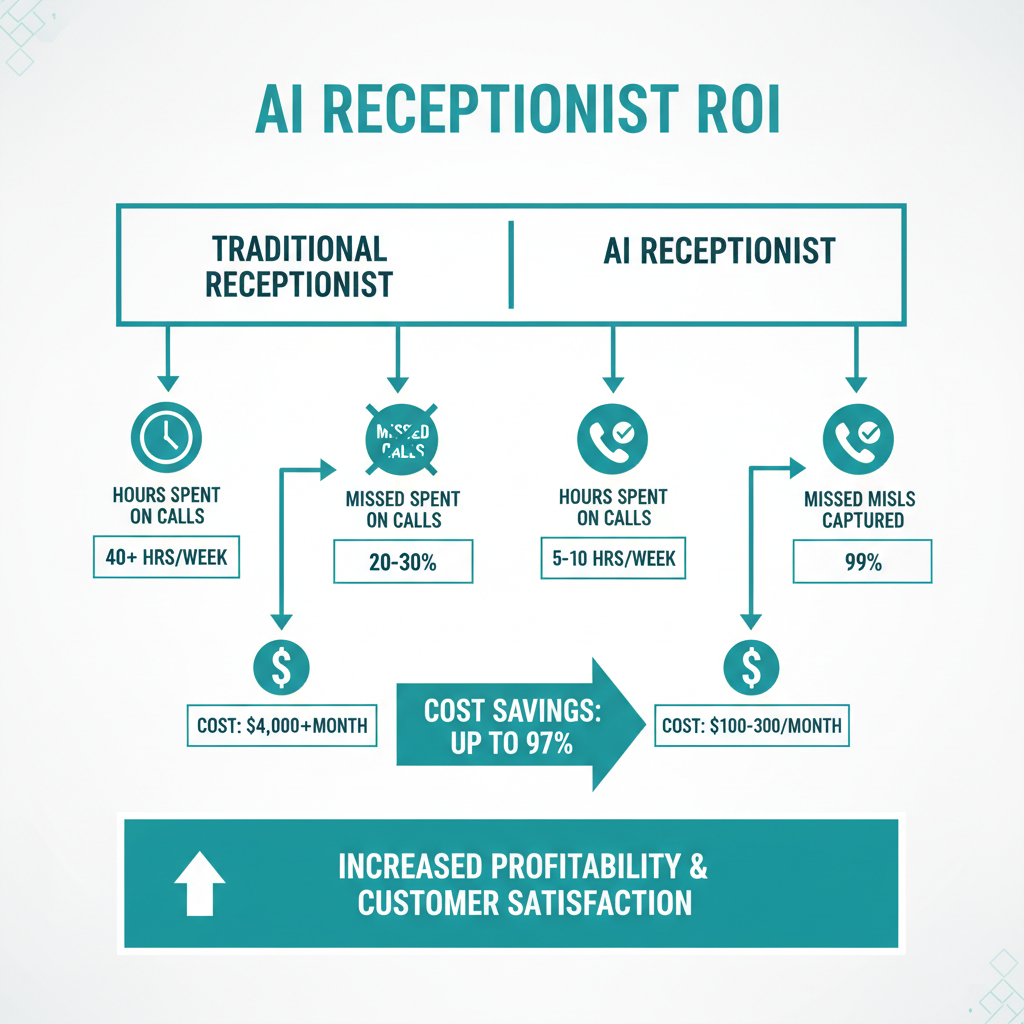
An AI receptionist refers to an automated software solution that handles inbound calls, schedules appointments, and answers customer inquiries. This technology typically costs between $50 and $300 per month, compared to a human receptionist who can cost $300 to over $2,000 monthly [6]. This massive price difference allows small- and mid-sized businesses to save up to 20% or more by using virtual assistants, with potential long-term savings reaching up to $250,000 over five years [6]. With a typical payback period of 10 to 18 months [1], scheduling automation represents one of the fastest-return investments available today.
By integrating these systems, service providers can easily review their operations through pricing plans designed to fit any business size. To learn more about our mission to help small businesses scale, visit About Conversify or read our related articles on automation.
What Is the Real Cost of Missed Calls for Service Businesses?
Up to 34% of customer calls to service offices go unanswered during business hours, and average hold times exceed 8 minutes [3]. According to industry data, these unanswered calls and long hold times cause 1 in 3 callers to hang up before reaching a staff member [3]. For service-oriented companies like salons, agencies, and repair shops, a missed call is not just an inconvenience; it is directly lost revenue.
For specialized service providers, up to 30% of inbound calls go unanswered during regular business hours [2]. Each missed call represents an estimated $850 to $1,300 in first-year customer revenue [2]. This missed call rate climbs to nearly 100% after hours, leading to significant monthly revenue leakage [2].
In fact, approximately 62% of phone calls to small businesses go unanswered, and 85% of people who do not get a response will not call back [8]. When a potential client hangs up, they usually call a competitor immediately. Implementing an AI receptionist can deliver a customized automated response within 30 seconds, leading to up to a 372% increase in lead-to-conversion rates [8].
A split screen showing a frustrated customer hanging up on a busy phone line versus a happy customer booking an appointment instantly on a smartphone.
How Much Can You Save with an AI Receptionist?
Gartner estimates that when AI autonomously resolves 80% of common customer service issues without human intervention, businesses see a 30% reduction in operational costs [5]. This significant reduction in overhead is paired with the fact that an AI receptionist is 10 to 20 times cheaper than a single human receptionist [5].
While human receptionists can cost $300 to over $2,000 monthly, AI receptionists typically cost between $50 and $300 per month [6]. For small- and mid-sized businesses, this massive price difference allows them to save up to 20% or more by using virtual receptionists, with potential long-term savings reaching $250,000 over five years [6].
Beyond the direct salary savings, service providers achieve a 30% improvement in administrative efficiency after implementing AI receptionists [3]. Seven out of ten routine calls can be handled start-to-finish without a staff member ever picking up the phone [3]. This frees up existing staff to focus on high-value, in-person client interactions rather than answering basic questions about hours, location, or pricing.
What Is the ROI and Payback Period of AI Scheduling?
Most service offices achieve a 300% to 500% net ROI (a 4x to 5x return) after implementing AI-driven scheduling assistants [1]. This return is driven by a 20% to 30% reduction in missed appointments and 10 to 15 hours saved per week in administrative work [1].
The typical payback period for AI scheduling assistants is 10 to 18 months, with some pilot deployments recovering costs in as little as 3 to 6 months [1]. This makes scheduling automation one of the fastest-return AI investments for service practices seeking rapid, measurable results [1].
Furthermore, a voice AI receptionist successfully captures and books an average of 40% of callers who would have otherwise hung up or left a voicemail [4]. Capturing just one additional new customer per month typically covers the entire software subscription cost [4]. This low barrier to profitability makes the technology highly attractive to small business owners.
How Does After-Hours Call Capture Drive Extra Revenue?
An analysis of over 1.4 million business calls showed that 28.5% of inbound calls arrive outside business hours, and 34.8% of those after-hours callers express buying intent [7]. This is a massive segment of the market that traditional businesses completely miss.
Interestingly, after-hours calls actually became a lead or booking 23.6% of the time, compared to 18.6% during business hours [7]. Callers who reach out after hours are often highly motivated to book immediately. If they reach an AI receptionist that can schedule them on the spot, they convert. If they reach a voicemail, they hang up and call the next business on their list.
With 81% of businesses that adopt AI receptionists keeping them after 12 months, and 87% of mature AI support teams report improved metrics, the long-term data is clear [7]. Long-term adoption yields better outcomes as the AI learns business-specific patterns and team workflows [7].
How to Transition to an AI Front Desk Step-by-Step
Transitioning to an automated AI front desk is straightforward when you follow a structured approach. Here is how service businesses can successfully implement this technology:
- Step 1: Audit Your Current Call Volume. Evaluate how many calls your business receives daily, when the peak times are, and what percentage of calls currently go to voicemail or remain unanswered.
- Step 2: Define Your Common Inquiries. Document the most frequent questions your front desk answers daily. This includes inquiries about business hours, location, parking, pricing, and booking policies.
- Step 3: Choose the Right AI Receptionist Platform. Select a platform like Conversify that offers unified messaging, including a WhatsApp shared inbox, AI auto-responses, and seamless appointment booking integration.
- Step 4: Train the AI on Your Business Patterns. Input your specific business details, FAQs, and scheduling workflows into the software. This allows the AI to deliver customized automated responses within 30 seconds [8].
- Step 5: Launch a Pilot Program. Run a pilot deployment for 3 to 6 months to monitor performance, recover initial setup costs [1], and allow the AI to learn your specific team workflows [7].
- Step 6: Monitor and Refine. Review call logs and booking metrics regularly. Since 87% of mature AI support teams report improved metrics over time [7], continuous optimization will yield increasingly better conversion rates.
AI Receptionist vs. Human Receptionist vs.
Traditional Answering Services
To understand whether an AI receptionist is worth the investment, it is helpful to compare it directly to traditional alternatives.
| Feature | AI Receptionist (e.g., Conversify) | Human Receptionist | Traditional Answering Service |
|---|---|---|---|
| Monthly Cost | $50 to $300 [6] | $300 to $2,000+ [6] | $150 to $600+ |
| Availability | 24/7/365 | Business hours only | 24/7 (often with per-minute fees) |
| Response Time | Under 30 seconds [8] | Variable (depends on busy lines) | Variable (long hold times common [3]) |
| Booking Capability | Instant automated booking | Manual booking | Basic message taking only |
| Cost Efficiency | 10x to 20x cheaper than human [5] | High overhead and benefits | Moderate (per-call charges add up) |
Frequently Asked Questions
Is an AI receptionist expensive to set up and maintain?
No, AI receptionists are highly cost-effective, typically costing between $50 and $300 per month [6]. This is 10 to 20 times cheaper than hiring a single human receptionist, who can cost anywhere from $300 to over $2,000 monthly [5], [6]. Most businesses find that capturing just one additional new customer per month completely covers the software subscription cost [4].
How long does it take to see a return on investment (ROI)?
Most service offices achieve a typical payback period of 10 to 18 months, with some pilot deployments recovering their entire cost in as little as 3 to 6 months [1]. Over the long term, businesses achieve an average net ROI of 300% to 500% [1]. This rapid return makes scheduling automation one of the most efficient investments for small businesses.
Can an AI receptionist handle bookings and scheduling autonomously?
Yes, AI-driven scheduling assistants can autonomously handle appointment bookings start-to-finish. Implementing these tools leads to a 20% to 30% reduction in missed appointments and saves administrative staff 10 to 15 hours per week [1]. This automation ensures that bookings are captured 24/7 without requiring any human intervention.
What happens to calls that the AI receptionist cannot resolve?
For complex inquiries that the AI cannot autonomously resolve, the system seamlessly escalates the interaction to a human staff member. While AI receptionists successfully handle 70% of routine calls without human intervention [3], they are designed to flag and hand off complex issues so that no customer query goes unanswered.
Do customers actually like interacting with an AI receptionist?
Yes, customers appreciate the speed and convenience of automated systems, especially when hold times on traditional lines exceed 8 minutes [3]. Because an AI receptionist can deliver a customized automated response within 30 seconds [8], it prevents the frustration of being put on hold or sent to voicemail, where 85% of callers will not call back [8].
How does an AI receptionist handle after-hours inquiries?
An AI receptionist operates 24/7/365, ensuring that the 28.5% of inbound calls that arrive outside business hours are answered instantly [7]. Since nearly 35% of these after-hours callers express buying intent, having an automated system in place allows businesses to convert 23.6% of these calls into bookings or leads [7].
Implementing an AI receptionist is a highly effective way for service businesses to capture missed revenue, lower operating costs, and improve front desk efficiency. With platforms like Conversify, businesses can automate routine tasks, capture after-hours bookings, and ensure that every customer receives an instant response. Given the rapid payback period and high net ROI, upgrading to an AI-powered front desk is a smart strategic move for any modern service provider.
Sources
- Average ROI of AI Scheduling Assistants
- AI Receptionists: The $2.1B Revolution Hitting Service Practices
- AI Receptionists in Healthcare: How Automation Is Transforming the Front Desk
- ROI Calculator
- What You Need to Deploy AI Answering Solutions
- Understanding AI Receptionist Costs: A 2025 Pricing Guide
- AI Receptionist Statistics
- Top 7 Benefits an AI Receptionist Brings to Your Business
David Friedman - Founder, Conversify · LinkedIn
David Friedman is a B2B operations leader with over 10 years of experience managing large-scale teams and business processes. After years of working with service businesses and seeing how much time was lost to manual customer communication, he founded Conversify, an AI-powered platform that helps healthcare practices and service providers across Europe automate their patient and client interactions. David built the platform from the ground up, working directly with practicing healthcare professionals to ensure every feature solves a real operational pain point. He is based in Spain.