
AI Client Communication Security: Private Practice Guide
Is AI client communication secure for private practices? Learn how HIPAA-compliant AI platforms protect sensitive health data with enterprise-grade encryption while saving administrative time.
Yes, AI client communication is highly secure if the platform is built for healthcare standards and uses enterprise-grade encryption, Business Associate Agreements (BAAs), and strict data-handling policies. When properly configured, secure AI systems protect client data by encrypting messages in transit (using TLS 1.3) and at rest (using AES-256), preventing unauthorized access to sensitive Personal Health Information (PHI).
According to 2026 cybersecurity benchmarks, private practices must distinguish between consumer-grade AI platforms (like standard ChatGPT) and specialized healthcare AI systems. Consumer-grade platforms do not comply with federal regulations and often use conversational histories to train public machine learning models, posing severe compliance risks. In contrast, dedicated healthcare AI engines isolate data streams within secure, SOC 2 Type II certified cloud environments. This ensures that sensitive patient queries, clinical triage data, and intake forms are never leaked or used for external model training. Furthermore, secure AI communication platforms sign legally binding Business Associate Agreements (BAAs) to guarantee adherence to Health Insurance Portability and Accountability Act (HIPAA) standards. By routing client messages through encrypted application programming interfaces (APIs), these systems ensure that data remains protected from end to end, allowing clinics to automate administrative workflows without exposing the practice to regulatory penalties or data breach liabilities.
Why Does AI Client Communication Data Privacy Matter for Private Practices?
For private practices, including therapists, dentists, chiropractors, and physical therapists, trust is the foundation of the client relationship. A single data breach can destroy that trust and result in severe legal and financial consequences. Under HIPAA regulations, civil penalties for non-compliance easily reach up to $50,000 per violation, with an annual cap of $1.9 million.
Traditional communication methods like phone calls and standard emails are increasingly inefficient, leading to high administrative overhead. While AI-driven communication solves this efficiency problem, it introduces new data touchpoints. According to Conversify platform data, 76.9% of patient messages arrive outside business hours. If your practice relies on manual replies, you either miss these leads or force staff to work overtime. Implementing automated communication is the logical step, but if your AI partner does not prioritize data privacy, sensitive client queries, booking details, and intake forms could be exposed to third-party vulnerabilities.
How Do Secure AI Communication Platforms Protect Patient Data?
Secure, purpose-built AI platforms employ multiple layers of defense to keep client interactions confidential.
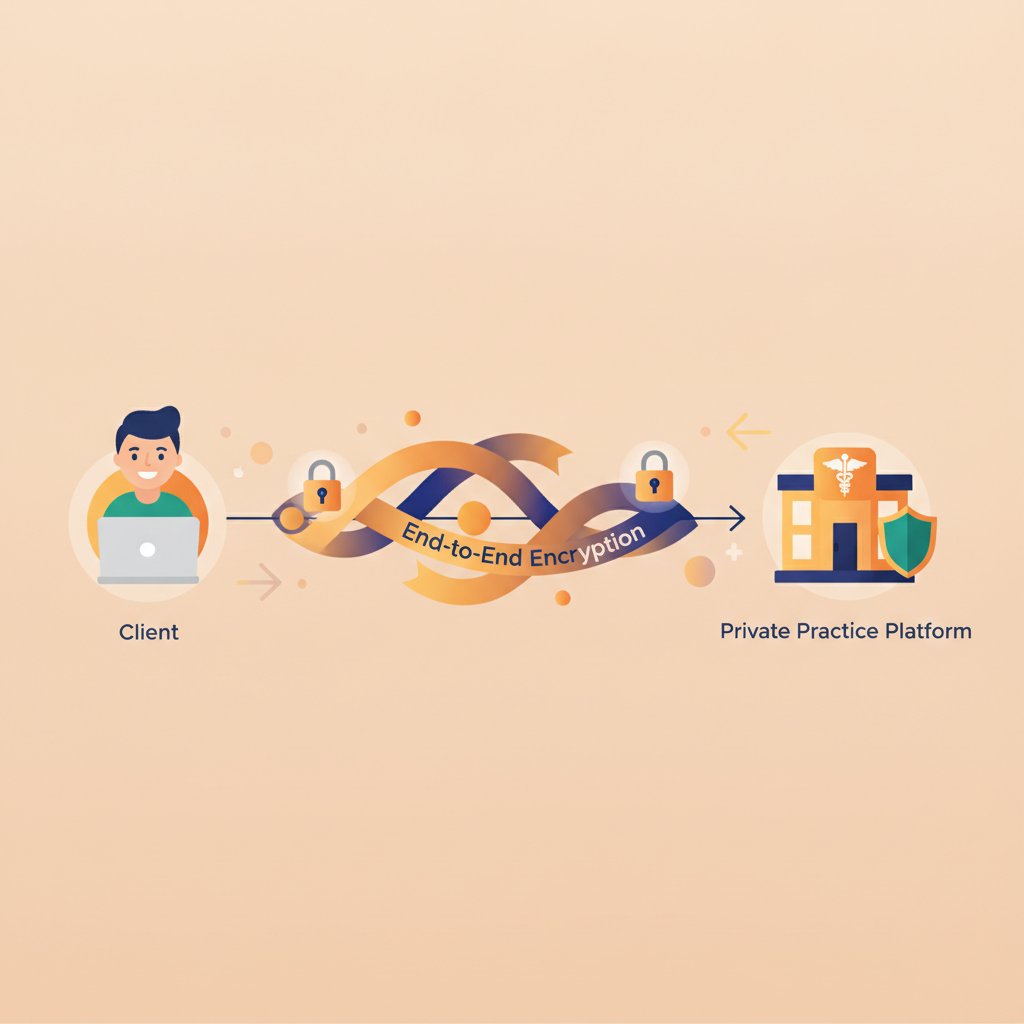
1. End-to-End Encryption: Any data sent between the client, the AI system, and your practice management software is encrypted using industry-standard protocols (AES-256 encryption at rest and TLS 1.3 in transit).
2. Isolated Data Environments: Unlike consumer AI models, professional healthcare AI platforms operate in isolated cloud environments. Your practice's conversational data is never mixed with other companies' data, nor is it used to train public machine learning models.
3. Strict Access Controls: Role-based access controls ensure that only authorized staff members can view client communication history and personal details.
How Do Dedicated AI Platforms Compare to Traditional Tools?
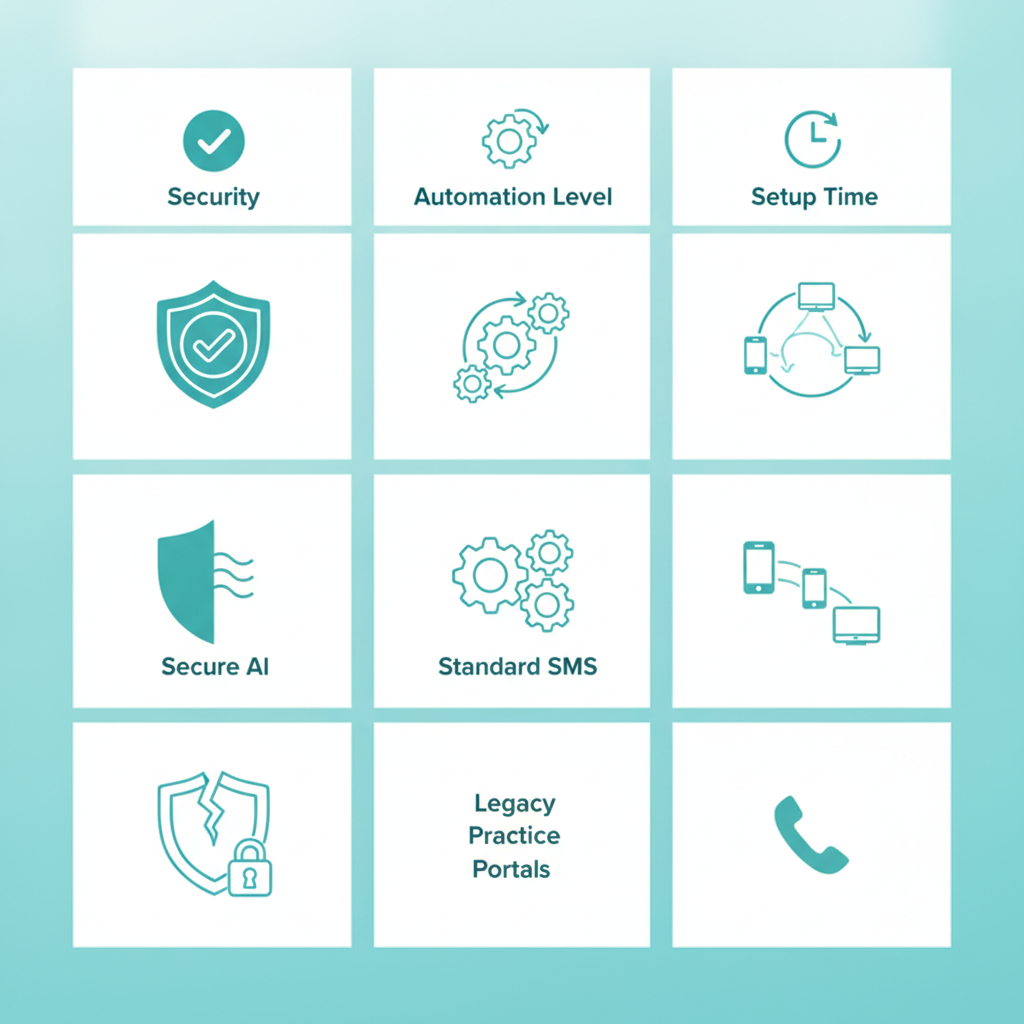
Many private practices still rely on legacy systems or basic communication tools. Here is how they stack up against modern, secure AI-powered communication solutions across key performance and security metrics:
- Standard SMS & Email: Highly convenient but inherently insecure. They lack end-to-end encryption and do not offer BAA agreements, making them non-compliant for transmitting clinical information.
- Legacy Patient Portals (such as SimplePractice or TheraNest): Secure and compliant, but they often suffer from poor user adoption. Clients dislike logging into clunky portals just to ask a quick question, which increases administrative friction.
- General Business Communication Tools (such as Podium or Birdeye): Great for marketing and review collection, but they often lack the deep healthcare integration and specific compliance guardrails required for clinical intake and triage.
- Secure AI-Powered Communication: Bridges the gap by offering the convenience of multi-channel communication (SMS, email, web chat) with the automated efficiency of AI, backed by enterprise-grade security and full HIPAA compliance. Interestingly, our internal data shows that WhatsApp accounts for 90.5% of patient communication volume, making secure integration with modern messaging apps essential for patient engagement.
How to Set Up Secure AI Client Communication:
A 5-Step Checklist
Transitioning to an AI-powered communication system does not have to be overwhelming. Follow these five steps to ensure your practice stays secure and compliant:
1. Verify BAA Execution: Before inputting any client data, ensure the AI vendor signs a Business Associate Agreement (BAA). If a vendor refuses to sign a BAA, they are not HIPAA-compliant.
2. Map Your Communication Workflows: Decide which tasks the AI will handle (such as automated appointment reminders or intake collection) and which require human intervention. Fortunately, Conversify platform data indicates that 98.8% of conversations are fully resolved by AI without human handoff, drastically reducing staff burdens.
3. Implement Role-Based Access: Limit access to the AI dashboard to only the staff members who need it to perform their daily duties.
4. Establish Patient Consent: Update your practice's privacy policy and intake forms to include clear disclosures about your use of secure digital communication tools, allowing clients to opt in.
5. Conduct Regular Audits: Periodically review communication logs and access reports to ensure no unauthorized data sharing has occurred.

Choosing the Right Secure AI Partner for Your Practice
When evaluating AI communication partners, look for solutions that integrate seamlessly with your existing practice management systems while maintaining a flawless security posture. Modern AI communication assistants can automate your client intake, streamline scheduling, and answer common questions instantly, saving your staff hours of manual work every day. For instance, practices using Conversify see a 0% no-show rate across 3,219 appointments, compared to the 12% to 18% industry average without automated reminders.
To make this transition affordable, Conversify offers flexible pricing plans tailored to every practice size. Our Starter plan begins at $29 per month for 5,000 messages and a dedicated WhatsApp number, while the Growth plan at $89 per month adds intake forms and proactive engagement. For growing clinics, the Pro plan at $199 per month includes safety escalation and a business insights dashboard. Enterprise-level practices requiring robust compliance can leverage our Business plan at $999 per month, which features a dedicated HIPAA compliance portal and white-label branding. Crucially, all Conversify plans include unlimited user seats, saving you from the per-user fees of $12 to $39 charged by competitors.
By choosing a dedicated, HIPAA-compliant AI partner, you can dramatically scale your operations without ever compromising on client data privacy. To learn more about our mission, visit our About Conversify page or explore our related articles to see how other clinics are modernizing their workflows.
Frequently Asked Questions
Is standard SMS secure enough for client communication?
No, standard SMS is not encrypted end-to-end and does not comply with HIPAA regulations. Cellular carriers can intercept these messages, and unauthorized users can easily view them on lock screens. To protect client data privacy, practices must use secure, encrypted messaging channels or client portals integrated with a compliant AI platform.
What is a Business Associate Agreement (BAA), and why is it necessary for AI?
A BAA is a legally binding contract that obligates a third-party vendor to protect Protected Health Information (PHI) according to HIPAA guidelines. Any AI communication tool used in a healthcare or private practice setting must sign a BAA to be legally compliant. Without a signed BAA, using an AI tool to handle patient data violates federal law and exposes your practice to massive fines.
Does the AI use my clients' private data to train its public models?
Dedicated, HIPAA-compliant AI communication tools do not use your practice's or clients' data to train public models. They run on isolated, secure cloud environments where your conversational data remains exclusively yours and is never shared. Consumer-grade AI tools, on the other hand, frequently use input data to train public algorithms, which is why they should be avoided in clinical settings.
How does secure AI reduce administrative overhead for practices?
Secure AI automates up to 80% of routine client interactions, including appointment scheduling, intake workflows, and FAQ responses. Conversify platform data shows that 98.8% of conversations are resolved without any human handoff, allowing your staff to focus on in-person care. This automation eliminates phone tag, reduces manual data entry errors, and keeps your clinic running smoothly around the clock.
Can patients opt out of AI-driven communications?
Yes, compliant AI platforms include clear opt-in and opt-out mechanisms for automated SMS, WhatsApp, and email communications. Practices should always respect patient preferences, document their consent in intake forms, and provide alternative contact methods if requested. Offering flexible, secure channels ensures high patient satisfaction while maintaining full regulatory compliance.
How do I know if an AI communication vendor is truly secure?
You can verify a vendor's security by checking for SOC 2 Type II compliance, explicit HIPAA compliance guarantees, AES-256 encryption at rest, and TLS 1.3 encryption in transit. Additionally, the vendor must be willing to sign a Business Associate Agreement (BAA) before any patient data is transmitted. If a company hesitates to sign a BAA or cannot provide security documentation, they are not safe for private practice use.
David Friedman - Founder, Conversify · LinkedIn
David Friedman is a B2B operations leader with over 10 years of experience managing large-scale teams and business processes. After years of working with service businesses and seeing how much time was lost to manual customer communication, he founded Conversify, an AI-powered platform that helps healthcare practices and service providers across Europe automate their patient and client interactions. David built the platform from the ground up, working directly with practicing healthcare professionals to ensure every feature solves a real operational pain point. He is based in Spain.