
How to Write HIPAA Compliant SMS Templates for Patient Outreach
Learn how to write secure, HIPAA compliant SMS templates for patient outreach. Protect your practice from severe fines with these copy-and-paste examples.
HIPAA compliant SMS templates are secure text message blueprints that exclude protected health information, limit content to neutral details like appointment times, and require documented patient consent. To remain compliant, these templates must exclude specific diagnoses and keep messages under the 160 character limit mandated by the FCC for automated healthcare texts. Implementing these compliant templates is vital, as research shows automated text reminders can reduce patient no-show rates by 30% to 50% [6]. However, failure to comply with federal regulations carries massive financial risks. A single non-compliant template sent to a bulk list of 500 patients can trigger 500 individual HIPAA violations [17], while TCPA violations can cost up to $3,000 per willful text [1]. This guide provides compliant templates and clear rules to protect your practice.
Why SMS is Essential for Modern Patient
Outreach (and the Risks of Getting It Wrong) Offering SMS outreach is no longer just a convenience; it is a critical patient retention tool, particularly for younger demographics like Gen Z and Millennials. In fact, a survey reported by Bandwidth found that 28% of patients are likely to switch healthcare providers if their current provider does not offer text messaging as a communication channel [16]. While the benefits of text messaging are clear, the financial consequences of non-compliance are severe. Under the Telephone Consumer Protection Act (TCPA), non-compliant text message campaigns can trigger statutory damages of $500 to $1,500 per violation, which can increase up to $3,000 if the violation is found to be willful [1]. Sending automated patient outreach messages without proper consent can easily lead to massive class-action lawsuits and severe financial penalties for healthcare practices [1]. 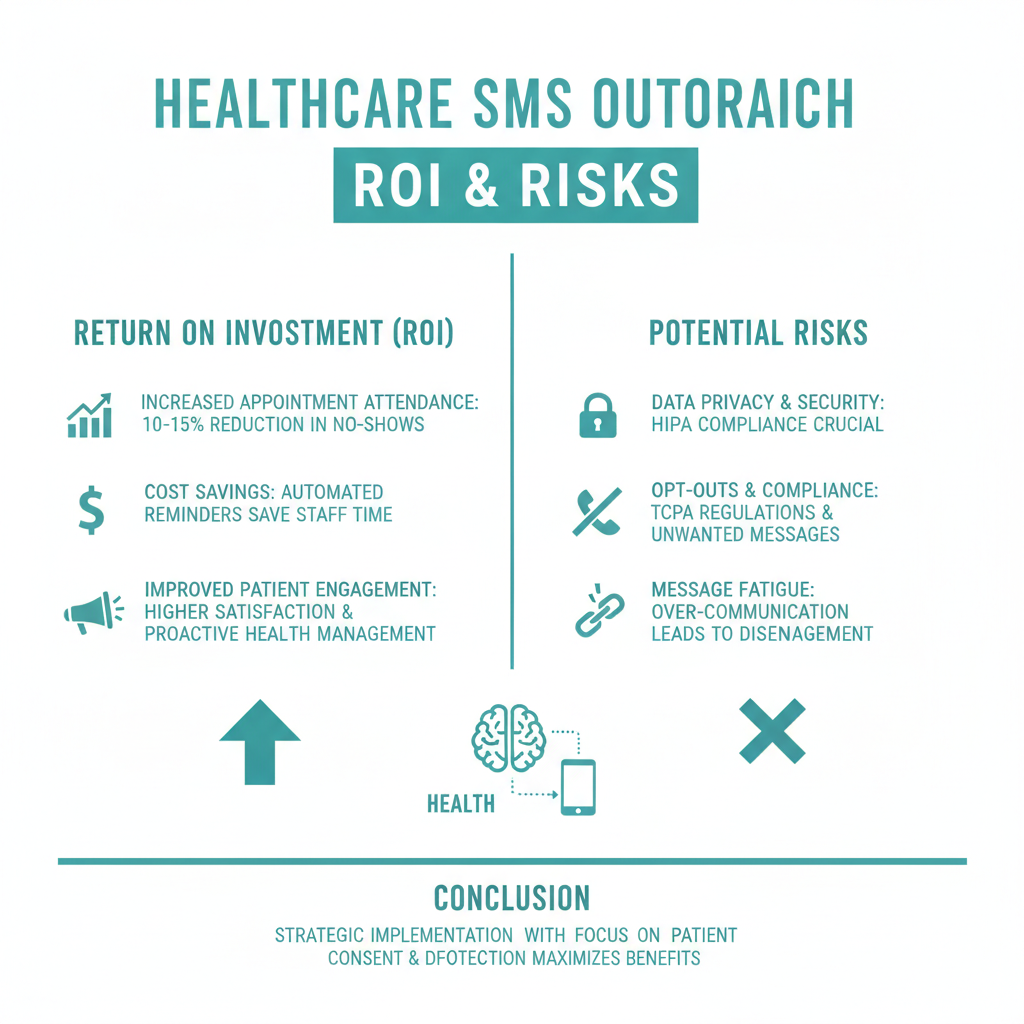 Furthermore, the Office for Civil Rights structures HIPAA fines on a per-incident basis [17]. A single data breach involving protected health information sent over unencrypted text messaging can cost a practice up to $50,000 in penalties according to HIPAA Journal [17]. Standard SMS carrier networks do not encrypt messages end-to-end, making it a violation to transmit specific diagnoses, treatment plans, or social security numbers over standard text [17].
The Core Rules of HIPAA Compliant Text
Messaging To build compliant templates, your practice must adhere to several federal guidelines, including the HIPAA Privacy Rule and Federal Communications Commission (FCC) regulations.
1. Adhere to the Minimum Necessary
Standard The minimum necessary standard under the HIPAA Privacy Rule dictates that SMS templates should exclude sensitive details like specific diagnoses, medication names, or treatment types [2]. Compliant templates must limit content to neutral details such as the provider name, date, and time, while routing sensitive clinical information through a secure patient portal [2].
2. Keep Messages Under 160 Characters
The FCC healthcare exemption limits automated healthcare-related text messages to a maximum length of 160 characters [13]. To remain compliant with federal telecommunications rules, SMS templates for appointment reminders and healthcare alerts must be kept concise and include an easy opt-out mechanism [13].
3. Provide an Easy Opt-Out Mechanism
Every automated text message sent to a patient must give them a clear and easy way to stop receiving messages, such as replying STOP [13].
4. Understand Section 164.506 of the
HIPAA Privacy Rule According to the HIPAA Privacy Rule, appointment reminders are classified as treatment communications under Section 164.506, meaning they do not require a separate, signed HIPAA authorization to send [2]. While providers do not need a formal, signed HIPAA authorization for reminders, they must still obtain patient consent to use SMS as the delivery channel and adhere to the minimum necessary standard [2].
5. Document Patient Requests for Unencrypted SMS Under Section 164.
522(b) of the HIPAA Privacy Rule, patients have the right to request communications via alternative means, including unencrypted SMS, provided they are warned of the risks and their consent is documented [2]. If a patient explicitly requests unencrypted texts after being informed of the security risks, a healthcare provider must honor the request and document the warning and consent in the patient record [2].
5 Ready-to-Use HIPAA Compliant SMS Templates
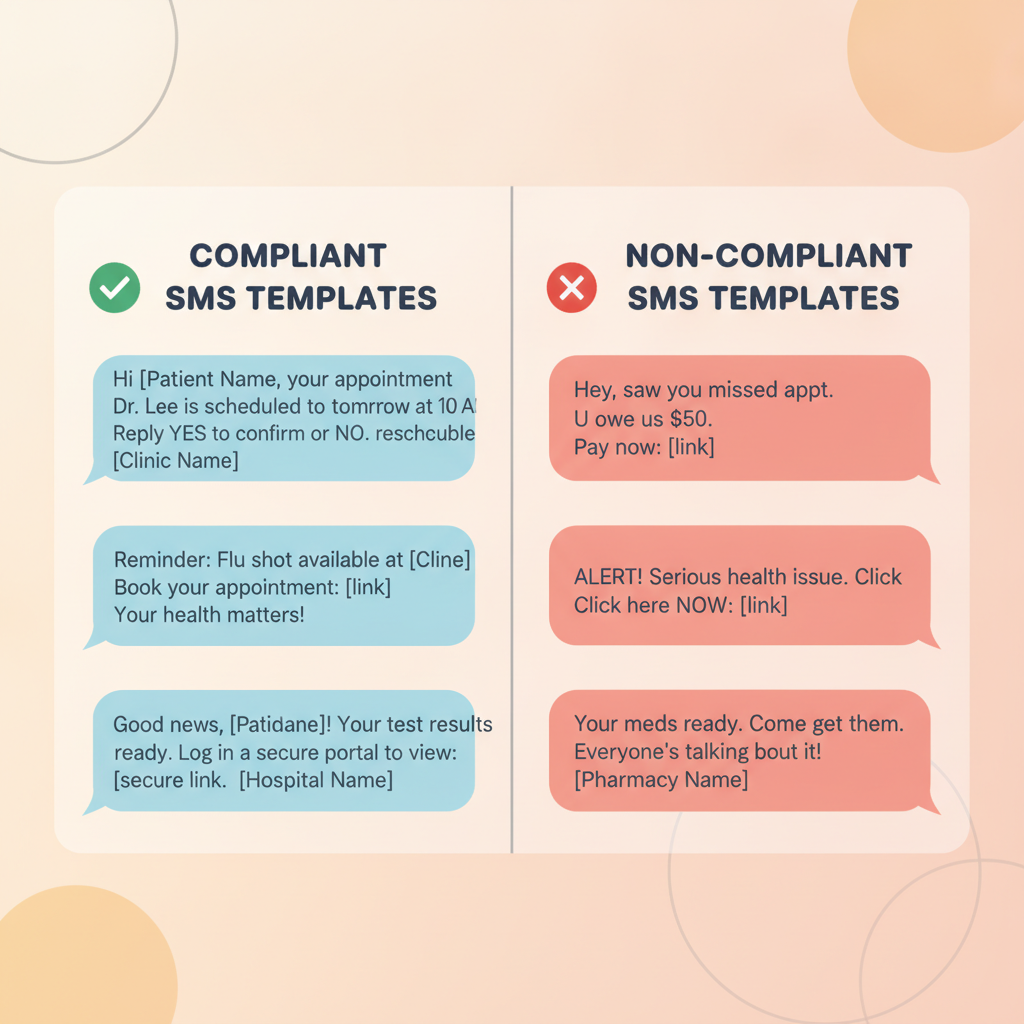
These templates are designed to remain under the 160 character limit, use neutral language, and include the necessary opt-out language.
Template 1: Appointment Reminder
- "Hi [Name], you have an appointment with [Provider] on [Date] at [Time]. Reply STOP to opt out."
- Why it works: This template keeps messages concise and strictly limits details to neutral scheduling information, ensuring compliance with both the FCC and the HIPAA minimum necessary standard [2, 13].
Template 2: Secure Portal Notification
- "Hi [Name], you have a new secure message from [Provider]. Log in to your secure portal to view details: [Link]. Reply STOP to opt out."
- Why it works: By routing specific clinical details to a secure portal, you avoid transmitting protected health information over unencrypted carrier networks [17].
Template 3: Patient Intake Request
- "Hi [Name], please complete your intake forms before your visit with [Provider] on [Date]: [Link]. Reply STOP to unsubscribe."
- Why it works: This template uses neutral phrasing and safely directs the patient to a secure, encrypted intake system [2].
Template 4: Post-Appointment Follow-Up
- "Hi [Name], thank you for visiting [Provider] today. Please share your feedback here: [Link]. Reply STOP to opt out."
- Why it works: It avoids mentioning any specific medical treatments or clinical outcomes, making it perfectly safe for standard SMS delivery [2].
Template 5: Wellness and Preventive Care Alert
- "Hi [Name], it is time for your routine wellness visit with [Provider]. Schedule your visit here: [Link]. Reply STOP to opt out."
- Why it works: Routine wellness alerts are categorized as treatment communications and do not require a signed authorization, provided they contain no sensitive diagnostic details [2].
How to Implement Compliant SMS Outreach
in Your Practice Implementing a compliant text messaging strategy requires combining the right templates with secure technology and clear internal processes. * Obtain and document consent: Always ask patients to opt in to text messaging during intake and document their consent in your electronic health record (EHR) system [2].
- Train your front-desk staff: Ensure your team understands that they cannot type out specific diagnoses, medications, or treatment plans in manual text replies [2]. Learn more About Conversify and how our AI-powered virtual receptionist can reduce administrative workloads by up to 40%.

Frequently Asked Questions
Do appointment reminders require a
signed HIPAA authorization?
No, under Section 164.506 of the HIPAA Privacy Rule, appointment reminders are classified as treatment communications, meaning they do not require a separate, signed HIPAA authorization to send [2]. However, providers must still obtain patient consent to use SMS as the delivery channel and adhere to the minimum necessary standard [2].
What are the penalties for sending
non-compliant text messages?
Under the TCPA, non-compliant text message campaigns can trigger statutory damages of $500 to $1,500 per violation, which can rise to $3,000 if the violation is found to be willful [1]. Additionally, a single non-compliant SMS template sent to a bulk list of 500 patients can result in 500 individual HIPAA violations, as the Office for Civil Rights structures fines on a per-incident basis [17].
Can I send specific diagnoses or medication
names over standard SMS?
No, standard SMS carrier networks do not encrypt messages end-to-end, making it a violation to transmit specific diagnoses, medication names, treatment plans, or social security numbers over standard text [17]. According to HIPAA Journal, a single data breach involving protected health information sent over unencrypted text messaging can cost a practice up to $50,000 in penalties [17].
What is the maximum length for automated
healthcare text messages?
The Federal Communications Commission (FCC) healthcare exemption limits automated healthcare-related text messages to a maximum length of 160 characters [13]. To remain compliant with federal telecommunications rules, SMS templates for appointment reminders and healthcare alerts must be kept concise and include an easy opt-out mechanism like replying STOP [13].
Can patients choose to receive unencrypted text messages?
Yes, under Section 164.522(b) of the HIPAA Privacy Rule, patients have the right to request communications via alternative means, including unencrypted SMS, provided they are warned of the security risks and their consent is documented [2]. If a patient explicitly requests unencrypted texts after being informed of the security risks, a healthcare provider must honor the request and document the warning and consent in the patient record [2].
How much do text reminders reduce patient no-show rates?
Sending automated text reminders can reduce patient no-show rates by 30% to 50% [6]. Implementing simple, compliant SMS templates helps clinics recover lost revenue and optimize their daily scheduling without increasing administrative workloads [6].
Sources * [1] [activeprospect.com](https://vertexaisearch.cloud.google.
com/grounding-api-redirect/AUZIYQFPVVOa1fj4BIQd_jMUir-KuuDoQaOkhA0UrPSW6oOer_lrN1QY0fL2id4UuXNWJ10ybNhpSenn2_l1ySnTBygNaOxJvsjMy2dScXYKtZICFvlLFnDfWBMwjJ3PBFKDCCF7pwk7WZy4c5sJV6e-6w==)
- [2] hollandhart.com
- [3] sinch.com
- [6] apptoto.com
- [12] hipaavault.com
- [13] falkonsms.com
- [16] bandwidth.com
- [17] hipaajournal.com By implementing these templates and maintaining strict boundaries around protected health information, your practice can safely benefit from the high open rates of text messaging while fully protecting patient privacy.
David Friedman - Founder, Conversify · LinkedIn
David Friedman is a B2B operations leader with over 10 years of experience managing large-scale teams and business processes. After years of working with service businesses and seeing how much time was lost to manual customer communication, he founded Conversify, an AI-powered platform that helps healthcare practices and service providers across Europe automate their patient and client interactions. David built the platform from the ground up, working directly with practicing healthcare professionals to ensure every feature solves a real operational pain point. He is based in Spain.